


A set of accounts is drafted once and reviewed three times. The draft takes an afternoon. The review takes a fortnight, because it is spread across a manager with four other files open, a partner who wants the tax return to agree to the accounts, and a preparer who gets the file back with a page of points on it, most of them presentation.
Nobody in a UK firm needs software to tell them this, and very little software has helped with it. Almost everything automated in accounts production over the last decade sits at the front of the process. Importing the trial balance, mapping it, rolling forward last year's file: the year end flow from trial balance to Companies House is a far smoother run than it used to be. All of that is useful, and all of it moved the bottleneck rather than clearing it.
Active has two AI capabilities built into the product. Both work on the review. Here is what each one does on a real client file.
What "AI built into Active" actually means
In accounts production, AI is most useful today as a checker rather than a writer. It reads a file that is finished or nearly finished, tests it against rules, arithmetic and the other documents in the job, and reports what does not agree. The accountant makes every judgement and signs the accounts.
Everything depends on where the AI sits when it does the work.
Paste a set of accounts into a general AI assistant and it will tell you something useful, but it has only seen what you pasted. It cannot open the tax return, and it keeps no record of what it read. So you check all of it before you use any of it, and the checking is the job you were trying to avoid.
AI built into Active starts from the file itself. It reads the trial balance, the financial statements and the workpapers as they sit in the job, and every finding lands back there with a location, a reason and a trail. A reviewer can test it against the file in seconds, which is what makes a review shorter instead of longer.
For firms that would rather use the AI tools they already have, there is a second route through Active's MCP server, covered separately in bringing your own AI to Active.
Review Assist: starting the review from a findings list
A manager opening a year end file has four documents that have to agree with each other: the financial statements, the trial balance, the tax return and the workpapers. None is difficult alone. The difficulty is holding all four at once, which is why the first hour of a review goes on getting the file into your head rather than reviewing it.
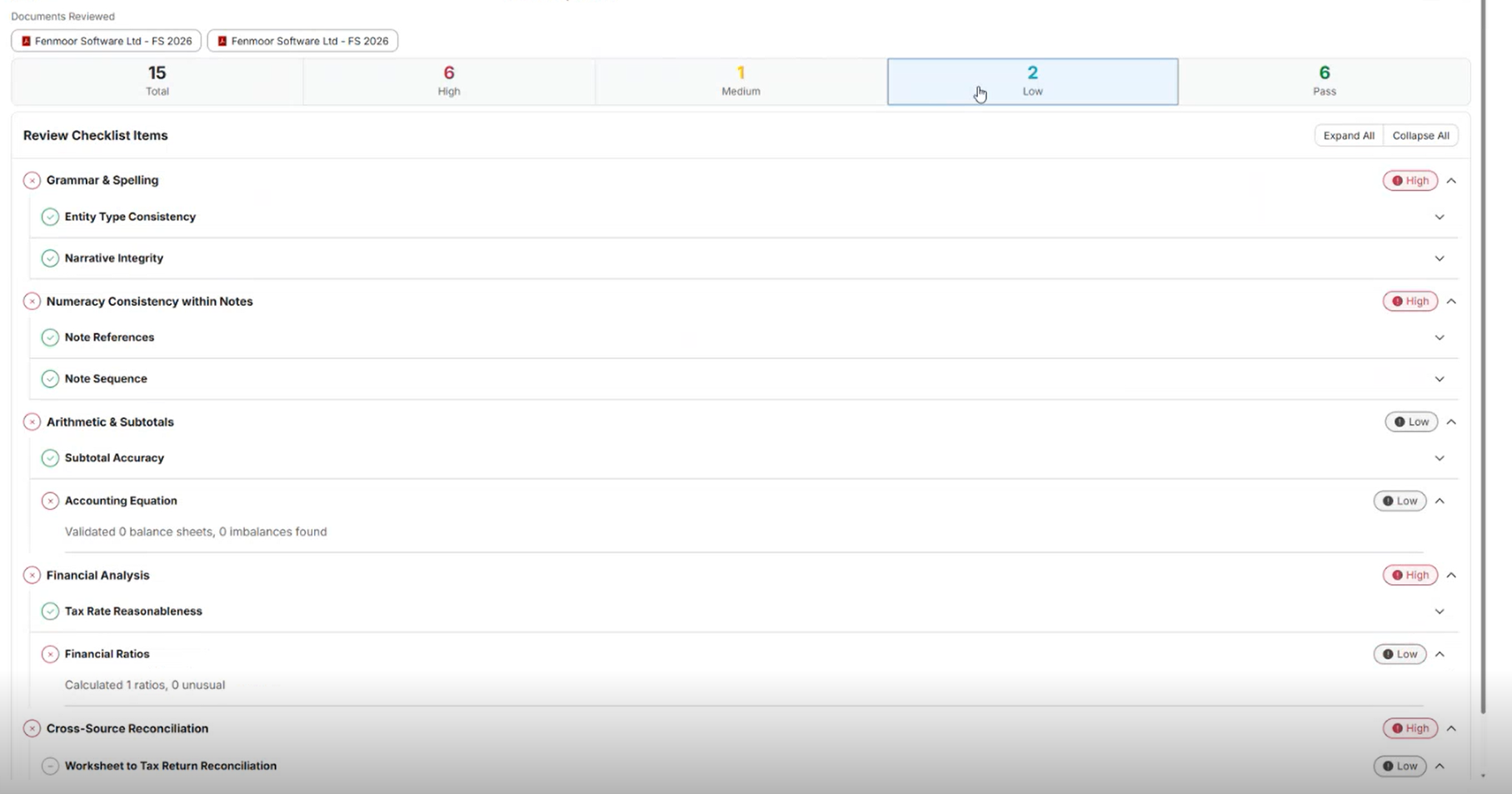
Review Assist does that pass first. It runs an automated review across all four sources at the same time and returns a findings report, so the reviewer opens a list of things to look at rather than page one of a set of accounts.
Those five categories are the full set today, and they run together on one pass. There is nothing to configure and nothing to prompt, so a firm does not need one person who has learned how to ask for the right review.
The next addition Active is working on extends the check to legislation itself, so that a change an accountant makes late in the review is tested against the rules as they stand and not only against the rest of the file.
The report is a starting point rather than a substitute for a review. Some findings will be immaterial and some will be wrong, and the reviewer disposes of them. What changes is that the mechanical comparison has been done in full, on every file, including the one arriving the afternoon before the deadline.
Inter-Entity Transaction Comparison: where the two sides do not agree
Any client with more than one entity generates transactions that appear in two sets of books. A recharge, a loan, a management fee, a transfer between companies. They are supposed to match. When they do not, somebody has to work out which side is wrong, and that means opening both files and working through them line by line.
Inter-Entity Transaction Comparison compares the transactions shared between entities and surfaces the anomalies where the figures do not match. What comes back is the list of items that disagree, which is the only part anyone wanted.
The gain here is not really speed. It is that the check gets performed the same way on every group, whoever picks it up and whatever week of the year it is. In a finished set of accounts, a comparison somebody eyeballed under time pressure and one run properly look identical. Only one of them is evidence.
Why both sit in the review stage, not the drafting stage
Read the two together and the pattern is deliberate. Neither writes your accounts. Both check work that already exists.
That follows from how the year end cycle behaves. Drafting is the visible part of accounts production and it is not the expensive part. A draft produced in half the time still has to be reviewed by a manager, corrected by the preparer and signed by a partner. If it arrives with nothing behind it, each of those people does more work rather than less. A faster first draft that takes longer to check is a slower year end.
What compresses the cycle is consistency between files. When every job has been prepared and checked the same way, the reviewer knows where to look and genuine exceptions stand out. That is the argument for enforceable standards without removing professional judgement across offices, and these two capabilities are the review-side half of it. The target is the number of times a file goes round, rather than the time taken to produce the first version.
It is also the honest answer to how you review AI generated accounts. You review them the way you review anything else, which is why output arriving with its source, its reason and its trail is worth more than output that simply reads well.
How Active keeps this safe to use on client data
Client data is safe in AI accounting software when a firm can answer two questions: where the data goes, and who inside the firm can use the tools at all. The AI built into Active runs in Active's UK data centres, the same place the rest of the product runs, under the same ISO standards, and you can read how client data is protected and certified in full.
The second question has a product answer. Active AI [PLACEHOLDER: Active AI hub page, /uk/ai or /uk/ai-solutions, not built] is one module, licensed per user the same way the rest of Active is, with no tiers and nothing further to unlock by paying more. A firm decides whether to take it at all, and if it does, which people get it. No licence means no connection at all: firms that want none of this carry on producing accounts and workpapers exactly as they do today.
That is a position rather than a caveat. Firms are in very different places on AI. Some have a written policy, some have a partner who will not have client data near a language model, and plenty have not had the conversation. None should have to settle an AI policy in order to close a year end.
If you want a sensible place to start, start where the work is checkable. Both operate on a file that already exists and leave their findings inside it, which makes them the least disruptive way to find out whether any of this earns its place.
The preview is free until 31 December 2026, a hard date rather than a rolling one. Firms come on by invitation and get the whole module with nothing held back, and every preview firm sees a price on the same day, well before December rather than in a renewal email.
We are walking through both on a live file at our webinar. To see them run against your own year end, take a look at Active's accounts production and book a demo.
Frequently asked questions
Does Active have AI built in?
Yes. Two AI capabilities sit inside the product: Review Assist and Inter-Entity Transaction Comparison. Both work on files that already exist, and both return findings into the job rather than as text you have to check somewhere else. They sit behind Active AI, one module licensed per user.
Can AI review a set of accounts?
It can run the checkable part of a review. Review Assist tests presentation and grammar, note references, arithmetic and financial analysis, and reconciles the financial statements, trial balance, tax return and tax workpapers against each other. Materiality, judgement and the decision to sign stay with the accountant.
Do I have to use the AI features in Active?
No. Active AI is one module, licensed per user, so a firm chooses whether to take it and which people get it. No licence means no connection at all. Firms that want no AI in client work carry on with accounts and workpapers as they are today.