
Hani Hagras is Professor of Artificial Intelligence at the University of Essex, where he is Director of the Computational Intelligence Centre and Head of the Artificial Intelligence Research Group. He is a Fellow of the IEEE and of the Institution of Engineering and Technology and winner of the 2026 IEEE CIS Pioneer Award for his contributions to explainable and generative AI. His work on explainable Agentic and Generative AI is at the centre of Active's partnership with the university.
We asked him how a firm can tell whether AI is safe to use on client work, what accountants should ask any software vendor, and what the industry is getting wrong. The interview has been edited for length and clarity. For how these principles show up in the product, read how Active approaches AI.
What is the University of Essex partnership doing in practice?
"We're working with Active within a UK-funded research initiative called a Knowledge Transfer Partnership, which brings universities to work with companies. The idea is to transfer the knowledge that has built up in the university, some of which isn't yet deployed in industry. Most of the technologies I'm talking about, explainable AI and explainable agentic AI, are not readily available in the industry, but we have that knowledge in the university.
This allows us to equip companies like Active with state-of-the-art AI techniques, and give their customers unique features: AI that improves operational efficiency, reduces risk, improves working conditions and lets firms do more work, so they see a real return on investment. Furthermore, explainability increases acceptance of the solution because people can see how it works."
Knowledge Transfer Partnerships are an Innovate UK programme that brings together businesses and academic experts to tackle strategic innovation challenges.
How does a reviewer find out why the AI raised a particular finding?
"As part of our work with Active, we'll provide AI features at different parts of the user journey. Account classification is an example. When you enter all of your accounts and you don't want to spend a lot of time determining whether something is sales or sales-related, the system will classify it for you.
We promote explainable AI, so any AI decision we produce will always be explainable. It will have what we call AI traceability. Whenever we produce a decision, you'll be able to trace it and understand exactly where it came from, so it can be easily understood, analysed and augmented by the business user. That will be embedded in everything we deliver to Active."
Why does explainability matter so much?
"Explainability is fundamental to how humans interact with everything around them. At the end of the day, humans trust what they can understand.
If I give you a prediction for an account and I can't describe where it came from, you won't trust it. And then you lose the value that automation and AI features are supposed to bring."
"At the end of the day, humans trust what they can understand."
If a client or regulator asks how AI was used on a set of accounts, what should a partner be able to show?
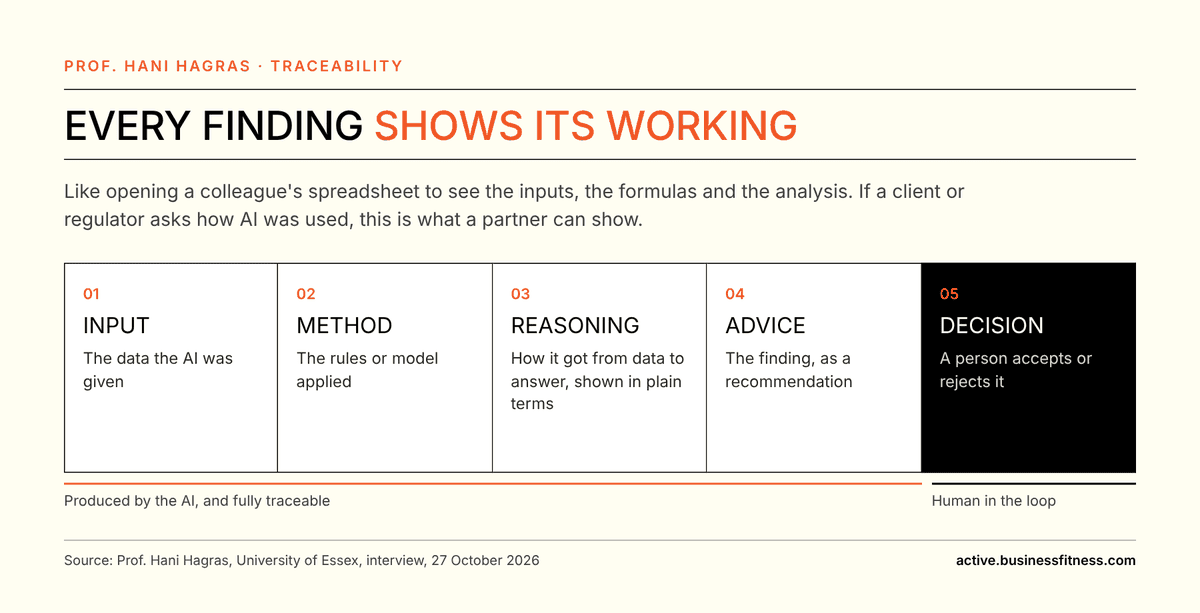
"The inner workings of the model. For each model, we provide an explanation of exactly how it reached its result, and it's shown in a very human way.
If you asked me how I came to a decision on a set of accounts, I'd just open the Excel file and say: this is the input, these are the equations I have done, this is the analysis I have followed, and this is exactly how I went from the input to the output. That is exactly what we are going to give."
When an AI output is wrong, how does a firm find out?
"You have to bear in mind that there is no such thing as an AI model that is 100% correct. AI takes inputs and, based on its own accuracy, produces an output.
However, if AI provides a decision and tells you it based it on this, this and this, you can exercise judgement on whether it can be trusted. It's like a conversation. Because you're human, if you give me an answer I can debate it with you and decide whether it makes sense. If you just give me an answer and can't say where it came from, I can't put any measure of accuracy against it.
That is how we approach AI: the same way people approach everything in life. With explainability and traceability, you can always tell whether it was a right or a wrong decision."
How should a job be divided between deterministic rules and AI?
"We always use AI to add value and give a return on investment. Deterministic rules have been used for a long time. They're trusted by the industry and by accountants. So wherever they exist and deliver value, we deal with the rest through AI models.
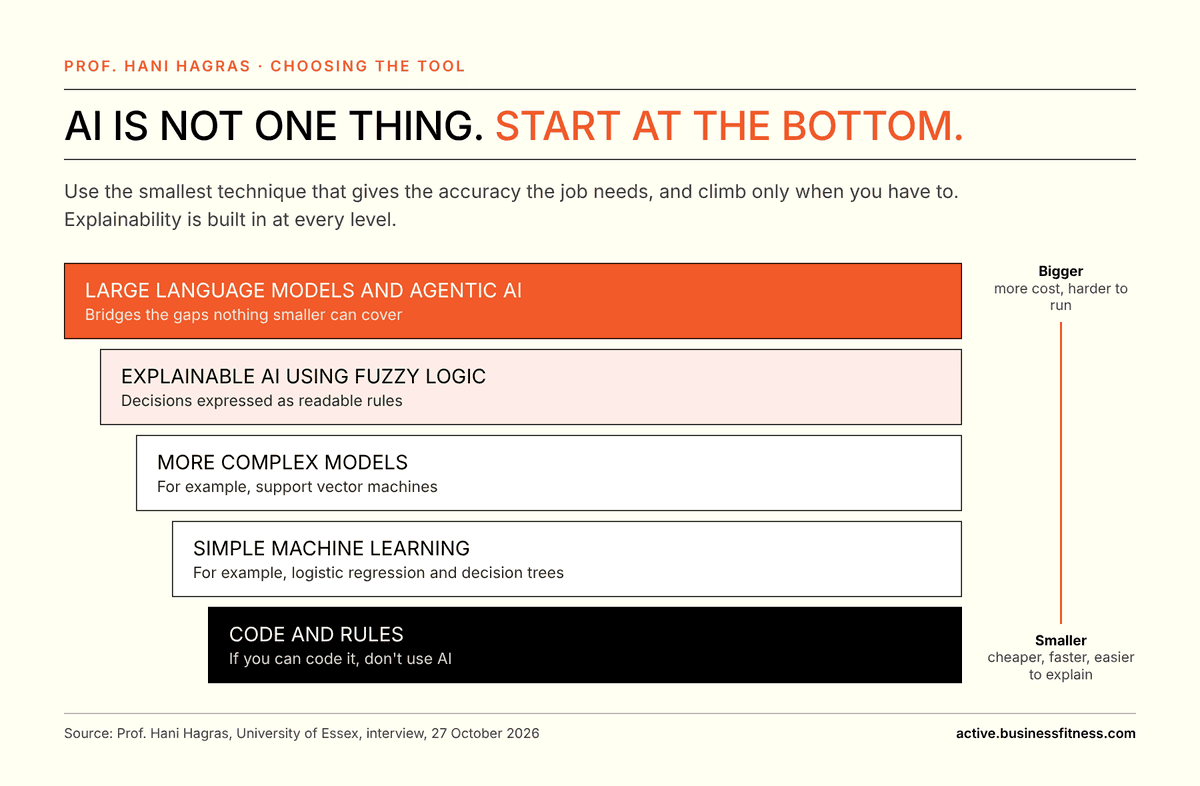
They don't need to be large language models. We always try to use the smallest model that gives the highest accuracy, which can be simple machine learning such as decision trees, or explainable AI models based on fuzzy logic systems. When needed, large language models and agentic AI are used to bridge the gap that rules can't cover."
What kinds of accounting task should a language model not be trusted with?
"AI is a tool. Furthermore, AI is not one thing. It is a huge number of techniques, from simple machine learning such as logistic regression, to more complex methods such as support vector machines, to explainable AI using fuzzy logic, to large language models and agentic AI.
When you use AI, use the smallest solution you can, and first check that you can't simply hard code it. If it's something that you can code, don't use AI. This is the biggest mistake people make. They assume AI is a silver bullet, without even thinking whether the problem can be solved with some Python code.
Second, make sure everything you do is explainable and transparent, so it can be trusted and you can qualify the accuracy of the model. Then AI can be applied across the whole suite, because we keep a human in the loop. I give you a decision, but my decision is advisory. You can act on it if you trust it, and you trust it because I explained it to you."
"If it's something that you can code with some Python code, don't use AI. This is the biggest mistake people make."
What should an accountant ask any software vendor about AI before trusting it with client work?
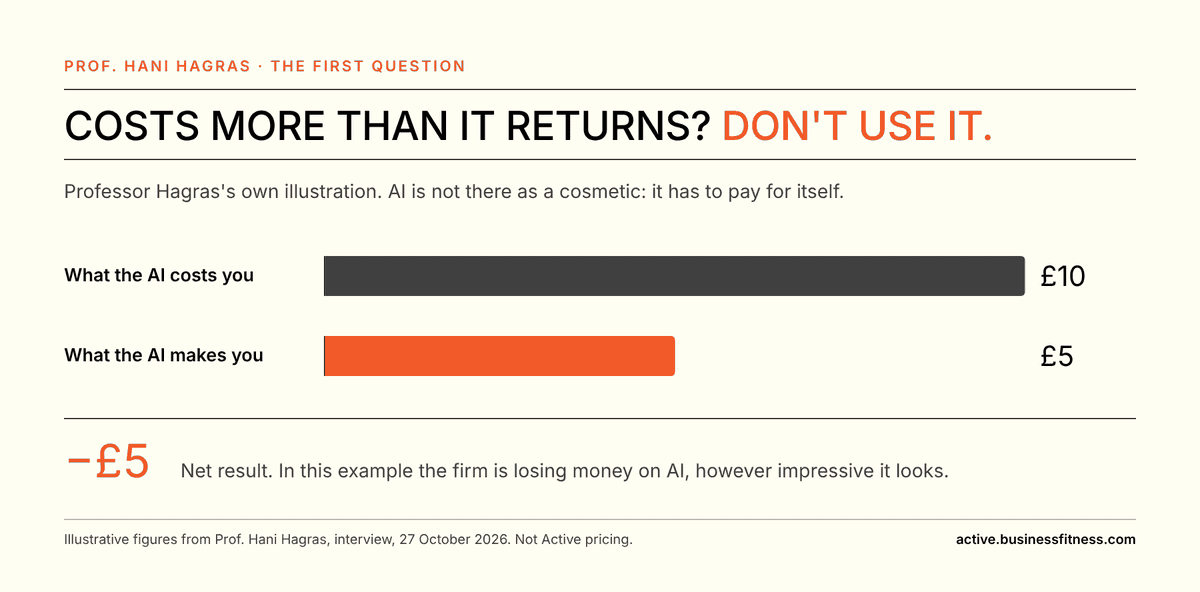
"First, what is the return on investment? AI is not there as a cosmetic. If I pay more for the AI than the benefit I get, I should not use it. If I pay £10 for the AI and it makes me £5, I lose money.
Second, what are the guardrails that let me trust it: how do you reduce its hallucination rate, how accurate are its predictions, and most importantly, how explainable and transparent is the model?
Third is sovereignty. Can I run this AI in a geographical location and a set-up that I trust?
Fourth is security. How secure is the AI solution? Could it be hacked? Because if it can, that could be disastrous. What guardrails do you put around it to keep my data secure and private?"

Is there an order of priority?
"All of them need to be present. Think of it like buying a mobile phone. If anyone can hack it, if it costs you more than it benefits you, or if you don't understand how it works and you cannot use it, each of those is a reason not to buy it. You can't trade one off against another."
What is the industry getting wrong about AI in accounting?
"AI is a tool, the same as the internet, web technologies and everything else computing has brought. Accounting has existed for thousands of years. It evolved from paper to computers, and now to software you can use from your phone. AI is the next step.
AI is not a threat. AI is not something which is going to make people redundant. It is another tool that is going to make humans more efficient. It takes away tasks that are time-consuming, like account classification, or merging, consolidating and correcting accounts, while making sure you are protected, so you can use that time to take on more work and grow your business."
"AI is not a threat. It is another tool that is going to make humans more efficient."
Firms are becoming more careful about client data and AI. How is that shaping the design?
"People are more nervous now about where their data will be and what kind of AI models are being used. A big topic emerging now is sovereign AI: AI whose data and models reside where you want them to.
It also means an AI solution has to be as efficient and cost-effective as possible."
Active uses a mix of smaller and larger models. Does that affect how well the system can explain itself?
"Explainability is baked into the solutions we design as a principle. Everything we use is explainable, big or small.
And we don't usually go for a big model when a smaller one gives similar performance. We always start with the most economical and most suitable model for the problem, to manage cost and efficiency. We start with things that can run on ordinary processors before going to specialist hardware. If I need to go bigger, I go bigger. But whether it's generative AI, agentic AI or machine learning, explainability is always built in."
Find out more
Read the overview of how Active approaches AI, the companion interview with Active's Chief Product & Technology Officer, Sean Devenish, and how Active protects and certifies client data. Active AI is free until 31 December 2026, by invitation. To see it on a live file, take a look at Active's accounts production and book a demo.
Frequently asked questions
What is explainable AI in accounting?
Explainable AI is AI that shows how it reached each output: the data it used, the method it applied and the reasoning in between. In accounting, it means a reviewer can test an AI finding against the file and a partner can show a client or regulator how AI was used.
What should accountants ask an AI software vendor?
Professor Hani Hagras suggests four questions: does it return more than it costs, what guardrails and explainability does it have, where does it run, and how secure is it. All four need good answers.
Will AI make accountants redundant?
Professor Hagras's view is that it will not. AI is a tool that takes on time-consuming tasks such as account classification, while the accountant keeps the judgement. AI decisions are advisory, and a person decides whether to act on them.