
Ask an accountant what worries them about AI and the answer is rarely that it will not be clever enough. It is that nobody will be able to say afterwards what it did, why it did it, and who checked it. A set of accounts is a signed document. "The software suggested it" is not something a partner can say to a client, a regulator or their own risk committee.
So the useful question about AI in accounts production is not what it can do. It is what it works inside: what it is allowed to touch, how its work is checked, and where the accountant's judgement sits.
This post sets out how Active answers that. It draws on two conversations. One is with Sean Devenish, Active's Chief Product & Technology Officer, who designs the platform the AI works in. The other is with Professor Hani Hagras of the University of Essex, whose research in explainable AI shapes Active's work with the university. Both interviews are published in full: Sean Devenish on Active AI and Professor Hani Hagras on explainable AI.
Active's approach to AI, in one paragraph
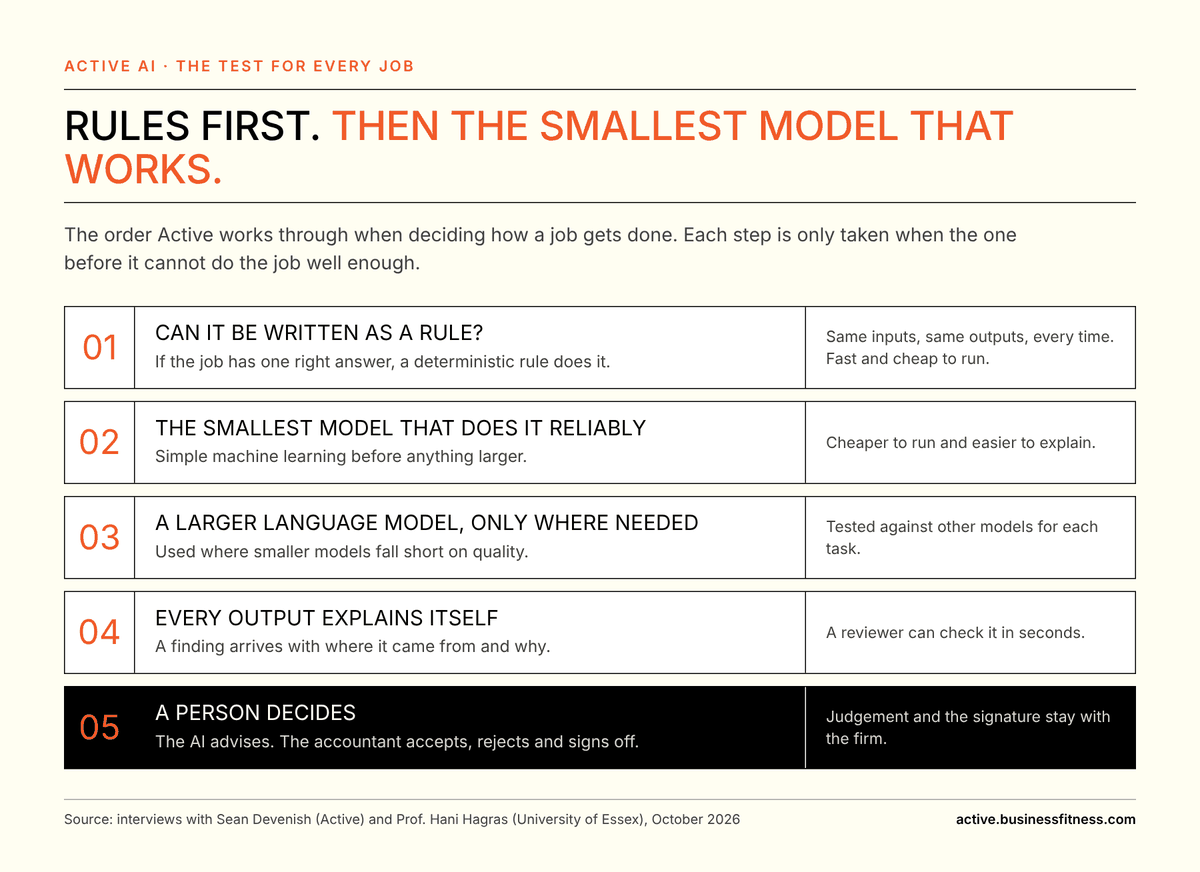
Active treats AI as work that has to be governed. Jobs with one right answer are done by deterministic rules. Where an AI model is needed, Active uses the smallest one that does the job reliably. Every output has to show where it came from, and a qualified person approves the result. AI works inside the same controls as your team.
The rest of this post takes those principles one at a time.
Deterministic or probabilistic: what’s the difference?
A deterministic process gives the same output every time it gets the same input. An Excel formula works this way: the same trial balance always gives the same total. AI language models are probabilistic. They work out the most likely answer, so the same question can produce a slightly different result from one run to the next. That makes them good at reading documents and drafting, and the wrong tool for anything that must come out identical every time, such as casting a balance sheet.
Borrowed from software engineering, rebuilt for accounts
Software development is the first profession AI changed at scale, and Sean has watched it happen from the inside. "I don't write code anymore," he says, "but we get ten times the output that we used to as a team."
His explanation for why engineers got there first is not that their AI was smarter. Everyone has access to the same models. It is that engineers already had the controls: one versioned source of truth, every task tracked and approved, automated checks before anything ships, and every change reviewed before it is accepted. AI arrived in a system that was already built to catch mistakes.
Accounts production has not had that layer in the same form. Active is building it as four parts that people and AI both work through:
- A system of record. One authoritative, versioned home for a client's documents and financial data, so a firm can always answer what happened, and when.
- Task orchestration. Checklists, to-dos and review points generated from templates and tracked to done, whether a person or an agent is doing the work.
- Calculation and reporting engines. The deterministic layer. The engine runs the numbers and produces the accounts. The AI can change the inputs, but it does not invent the outputs.
- A review framework. Approvals, an audit trail and version history, so there is evidence of who reviewed what, and what it looked like when they signed it off.
Two things are different from software, and Sean is clear about both. Accountants version documents rather than lines of code. And they spend far more time chasing information they do not yet have, from clients, other systems and inboxes. That second difference is where much of the early value sits.
Rules first, then the smallest model that does the job
Talk to the people building AI into Active and the principle that comes up most is about when not to use it.
"If it's something that you can code, don't use AI," says Professor Hagras. "This is the biggest mistake that people make. They assume that AI is a silver bullet."
Sean describes the same rule from the engineering side. A deterministic rule gives the same answer every time, runs quickly and costs little. A model is flexible and can start straight away, but its answers can vary. So the more a job depends on reliability, repeatability and speed, the more it belongs to a rule.
They come at it from opposite ends, which is worth seeing. Hani starts with rules and brings in models for whatever the rules cannot reach. Sean's team often lets the AI take on a job first, then writes rules wherever it is slow, unreliable or not good enough. Both end in the same place: anything that must give the same answer every time becomes a rule, and the AI handles what rules cannot.
When a model is needed, its size is a decision too. Active tests each task against a range of models and picks the smallest one that gives the quality it needs. Smaller models are cheaper, quicker and easier to explain. A larger language model is used where nothing smaller is reliable enough.
That is also why the numbers in a set of accounts are not generated by a language model. The calculation engine runs them, the same way every time. It is the same reason firms have kept Excel for so long, and why Active's approach to workpaper automation keeps what works about Excel.
Every answer has to show its working
An AI finding that a reviewer cannot test is not a finding. It is one more thing to check.
Professor Hagras puts trust at the centre of the design. "At the end of the day, humans trust what they can understand," he says. The rule he brings to Active is that every AI decision is traceable: what data went in, what method was applied, and how the system got from one to the other.
He compares it to asking a colleague how they reached a number. "I'll just open the Excel file and say, this is the input, these are the equations I have done, this is the analysis I have followed." That is the standard to hold AI to. If a client or regulator asks how AI was used on a set of accounts, a partner should be able to show its working in the same way.
Explainability is also what makes the human in the loop real rather than nominal. No AI model is right every time, Hani points out. What protects the firm is that each AI output is advisory and arrives with its reasoning, so the accountant can judge it. "You can execute it if you trust it, and you trust it because I explained it to you. If not, don't use it."
In Active, that happens in the review framework. The AI already built into Active returns each finding into the job with a location and a reason, and the reviewer decides what to do with it.
Two ways in, the same controls underneath
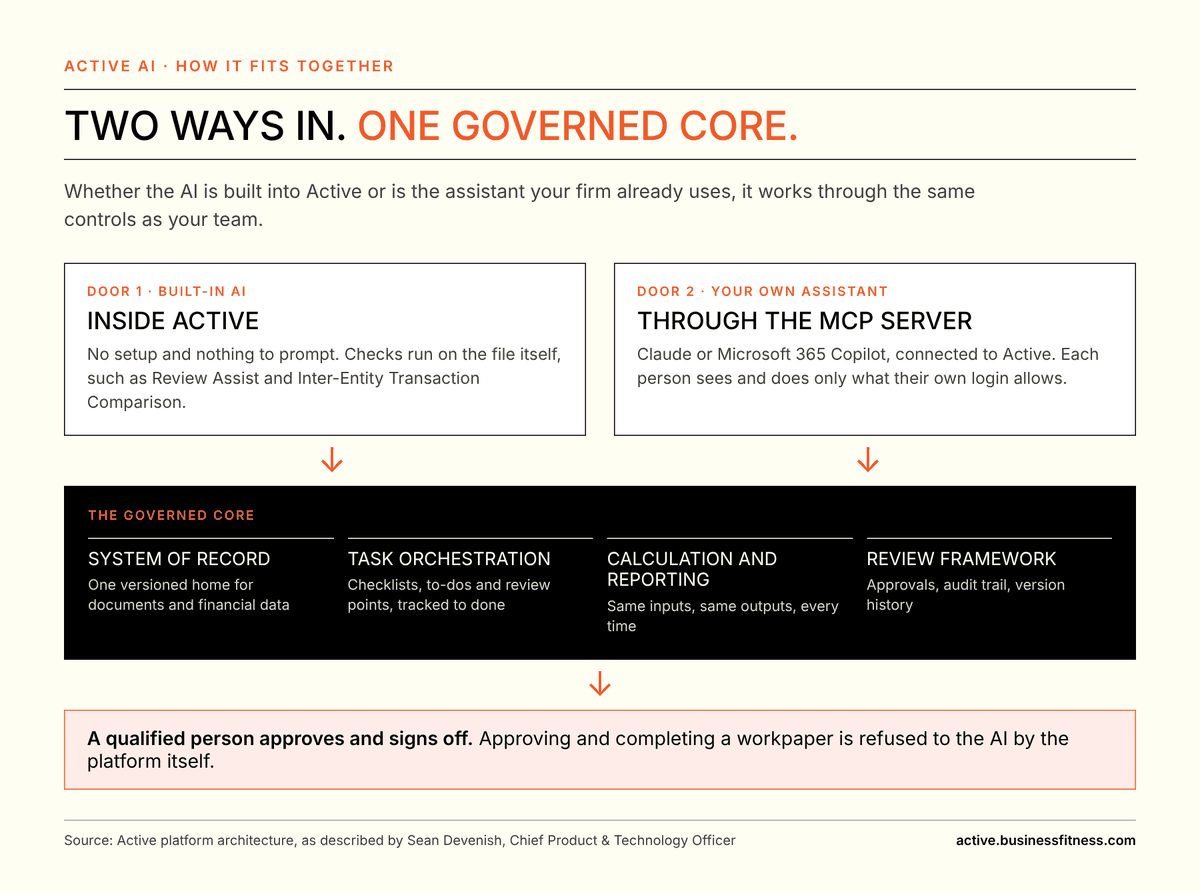
AI reaches a client file in Active in two ways.
The first is built into the product, with nothing to set up and nothing to prompt. Review Assist and Inter-Entity Transaction Comparison both check work that already exists.
The second is the assistant your firm already uses. Through Active's MCP server, Claude or Microsoft 365 Copilot can work with your client files in plain English. Five of the jobs it can do today are covered in bring your own AI to Active.
Why not build an Active chatbot instead? Sean's answer is that the quality of an AI assistant comes from two things: the model, and the harness around it, meaning its memory, its instructions and its ability to use other tools. The large AI companies are racing to build better harnesses, and an accounts software vendor building its own would only ever offer a fraction of that. So Active built the tools and opened them up. "The open standard," he says, "gives the best outcome for the user by a long way."
Both routes lead to the same governed core. An assistant connected through the MCP server signs in as the person using it, and can never see or do more than they can. Some actions are refused to AI by the platform itself, whatever rights the person holds. Approving and completing a workpaper is one of them.
Where client data goes when AI runs
The answer depends on the route.
When a firm connects its own assistant, the firm decides which assistant can reach Active, and each person signs in as themselves. The assistant receives only what that person asks for, at the moment they ask for it.
When an AI feature built into Active runs, Active calls the language model on the firm's behalf, through Microsoft Azure. Active is moving every one of those calls to processing in Europe, and limiting itself to the models available in Azure’s European regions to do it. Until that work is finished, some calls may be processed outside Europe.
Active is certified to ISO 27001 and Cyber Essentials, and you can read how client data is protected and certified in full. Active is also working towards ISO/IEC 42001, the international standard for managing AI systems.
What changes for the accountant
The accountant keeps the judgement and the signature. What changes is where their time goes.
Sean's example is the client query letter. Compiling one by hand, working out what was asked for last year, what has arrived and what is still missing, can take "easily half an hour to compile a query letter, if not an hour to two hours." With Active's tools, an AI agent does the gathering in about five to ten minutes while nobody is at the keyboard. A person then reviews the result in a few minutes.
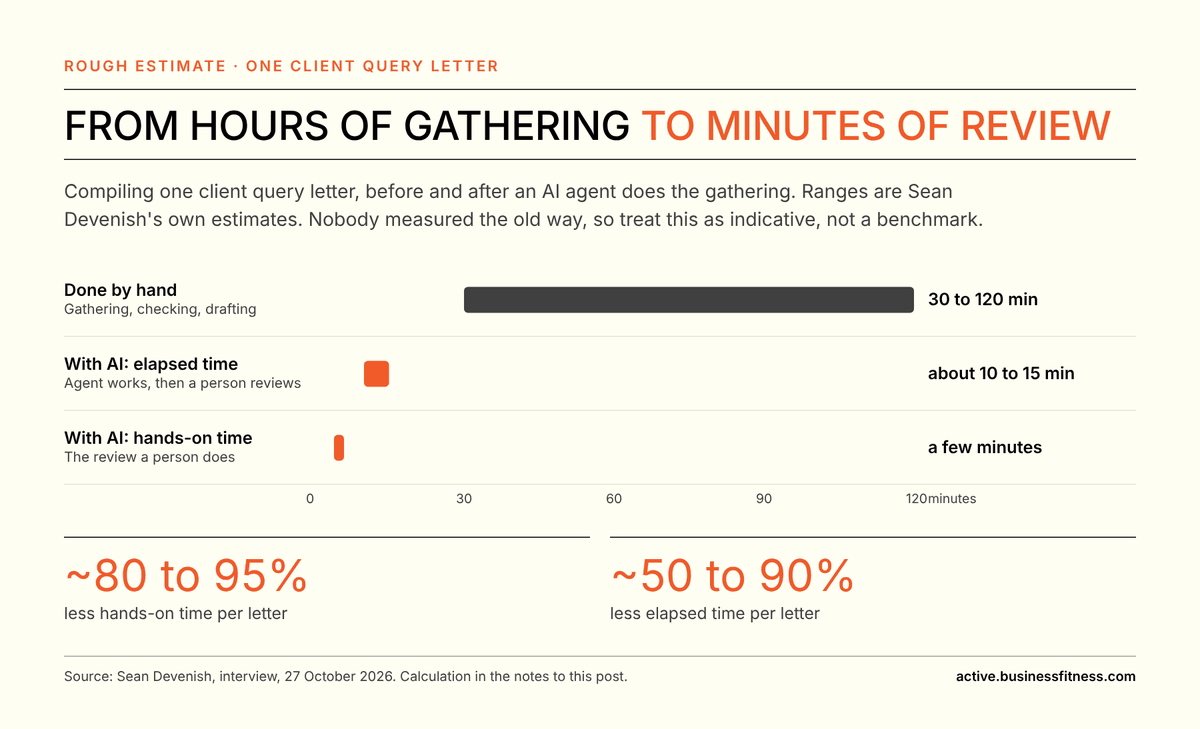
Nobody measured the old way, so these are Sean's estimates rather than a benchmark. On his figures, the hands-on time for one letter falls by roughly 80 to 95 per cent.
"It does change fundamentally what the accountant is doing," Sean says. "Historically the accountant spent a lot of time doing grunt preparation, whereas now it really just moves into a review approach." The accountant still has to show they saw the work, approved it, and know what it looked like when they signed it off. AI on its own is not good at that, which is exactly why the review framework exists.
Professor Hagras sees it the same way. "AI is not a threat. It is another tool that is going to make humans more efficient."
For firms that are not ready, nothing changes. Active AI is one module, licensed per user, and a firm without it carries on producing accounts and workpapers exactly as it does today. That is how enforceable standards without removing professional judgement works in practice: the firm decides.
Four questions to ask any AI vendor, including us
Professor Hagras offers a simple test for any AI software, and we are happy to be held to it.
| Question | What to ask |
|---|---|
| Return on investment | Does it make the firm more than it costs? |
| Guardrails and explainability | How accurate is it, how is hallucination kept down, and can you see how it reached each answer? |
| Sovereignty | Where does the AI run, and is that somewhere you trust? |
| Security | Could it be attacked, and what keeps client data secure and private? |
Where to start
Active AI is free until 31 December 2026, a hard date rather than a rolling one. Firms come on by invitation and get the whole module, with nothing held back.
If you missed our 28 October webinar, the replay walks through both routes on a live file. To see Active's AI run against your own year end, take a look at Active's accounts production and book a demo.
Frequently asked questions
How does Active use AI?
Active uses AI in two ways: features built into the product, such as Review Assist, and an MCP server that lets a firm's own assistant, such as Claude or Microsoft 365 Copilot, work with Active. Both work through the same controls, and a qualified person approves the result.
Can I see why Active's AI flagged something?
Yes. Explainability is a design rule in Active: each AI finding is returned into the job with where it came from and why it was raised, so a reviewer can test it against the file before accepting or rejecting it.
Does AI replace the accountant in Active?
No. AI in Active is advisory. It can gather information and check work, but approving and completing a workpaper is refused to it by the platform. The accountant keeps the judgement and the signature.
Where is client data processed when Active's AI runs?
With your own assistant, your firm chooses the assistant and each person signs in as themselves. Built-in features call language models through Microsoft Azure, and Active is moving every call to processing in Europe.
Do I have to use AI in Active?
No. Active AI is one module, licensed per user. A firm chooses whether to take it and which people get it, and a firm without it carries on with accounts and workpapers as it does today.