
Sean Devenish, a Chartered Accountant, is Active's Chief Product & Technology Officer, and he works at the point where software engineering meets accounting. His team has seen AI change how software gets built. Now he is building the equivalent for accounts production.
We asked him how Active approaches AI, why it chose an open standard over its own chatbot, and what changes for the people who sign the accounts. The interview has been edited for length and clarity. For the short version of the approach, read how Active approaches AI.
If you had two minutes with a partner and could not name a single feature, how would you explain Active's approach to AI?
"It's about enablement. We want any AI agent to be able to do good work in our system. So rather than trying to build every process a firm might want, or define every automation it might need, we provide a layer of tools that AI can use. Any AI, anywhere in the firm's ecosystem, can use Active to get the underlying work done.
The AI does the coordination. We're the platform it uses to understand what it has to do, and to get all the material and data it needs to get the job done."
Where did that approach come from?
"A lot of it comes from watching what AI has done to software development. As a software developer I've seen massive changes in our productivity and the way we build code, and that's been driven by agents doing the vast majority of the work. I don't write code anymore, but we get ten times the output that we used to as a team.
So the obvious question is why we're not seeing that in accounting yet. Why isn't an accountant doing work in a tenth of the time? A lot of what I do is look at that transformation in software and translate it into accounting.
The main lesson from software is that AI does the work, but you need a lot of oversight over it. Software has standard processes and tools to regulate AI work. So in our platform we provide those oversight and review layers and controls, so the agent can do its work and the firm can still keep a hand on it and make sure it does what it's supposed to."
When did that settle?
"Really only in the last three to four months. For a long time everyone, including us, was looking at how to get AI to do specific things inside our application. That has flipped. Now the question is how you review AI in the process, and that changes the way we look at the product and what we build for the market.
Client query management is a good example. We had a register of client queries, and we were building processes to help you compile those queries and look at last year's job. We found it was better to have a framework for logging queries, and make that framework available to AI so it can create the queries itself.
So an agent, take Claude for example, can look at what we already know about the client. It can look at last year's job to work out what we expected to receive, look at the data we've got so far this year, and work out the difference. When it identifies, say, four or five pieces of information we still need from the client, it records them in our register, so they're formally documented and tracked over time. It can draft the email to the client, and later check whether the client's replies actually answer each of those questions."
Editor's note: what this looks like in practice is in bring your own AI to Active, including a video of the query round-up running in Claude.
Where does that leave the accountant?
"Reviewing it, and signing it off. You've got to prove that you saw it, that you signed it off, and what it looked like when you signed it off, which AI on its own is not very good at, because it eagerly makes changes on your behalf. So a lot of what we build is about controlling and reviewing that work.
It does change fundamentally what the accountant is doing. Historically the accountant spent a lot of time doing grunt preparation. Now it really moves into a review approach, where you're reviewing what the agent has prepared."
"You've got to prove that you saw it, that you signed it off, and what it looked like when you signed it off."
Has it saved time yet?
"We can't measure it exactly, because nobody knows how long they spent in the old approach. There's no baseline to measure against. But anecdotally, it can easily take half an hour to compile a query letter, if not an hour to two hours to scan everything. We can do the same thing in about five minutes. Even if it takes ten, I'm away from the keyboard while the AI does the work. Then it's really just a few minutes for review.
And because AI can do more work than a person has time for, we can make the review easier as well. It can spend more time summarising things, putting in cross-references and building documents that explain things better, which a person normally wouldn't have time to do."
Editor's note: on Sean's own figures, the hands-on time for one query letter falls by roughly 80 to 95 percent. These are his estimates, not measured results. The calculation is shown in How Active approaches AI.
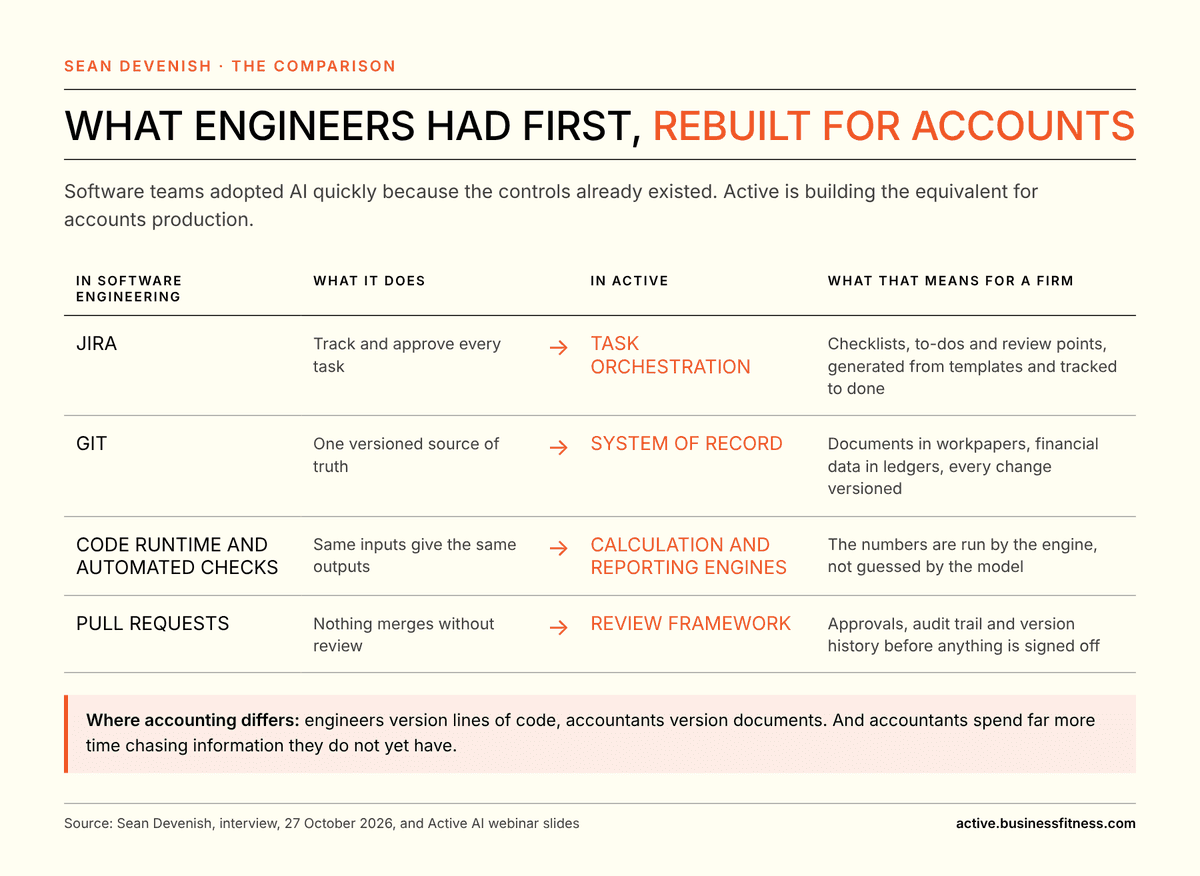
Active compares its approach to the tooling software engineers already have. How far does that hold?
"Very directly, across a whole range of things. There are accounting differences, which is why you can't just use software development tools to do accounting work, but the processes are fundamentally very similar.
A software developer has a framework for tracking every single change AI makes, line by line. You can't do that in accounting, because accounting is more document-centric. So we version documents instead of lines of code. When a developer reviews, they're agreeing that this code becomes the new state of the code. An accountant is signing off a financial report. Different artefacts, but the same process.
The main thing accountants have that software developers don't is how much information they need. When you're writing software, all the code is there. An accountant is often working with incomplete information and has to keep working out where to get it. Do I ask the client for that document? Is it in another system? Is it in an email? Do I go to the regulator? There's a lot more information wrangling in accounting."
What are the parts of the platform underneath?
- System of record. One authoritative version of every client's information, structured and unstructured. Documents live in workpapers and financial data lives in ledgers, with access control and versioning, so a firm can always answer what happened, and when.
- Task orchestration. Work planned from templates and checklists rather than from memory. The questions it answers are what needs doing, who is doing it, a person or an agent, and whether it is done.
- The deterministic layer. Two engines with one rule: the same inputs give the same outputs, every time. The workpaper engine runs the numbers. The reporting engine turns approved workpapers into finished accounts. The AI changes the inputs; it does not calculate the outputs.
- Review framework. Nothing is final without evidence of review: approvals, an audit trail of who changed what and why, and version tracking that can be locked down. Agents can raise and answer review points. People sign off on agent and human work alike.
How do you decide whether a job is handled by deterministic rules or by AI?
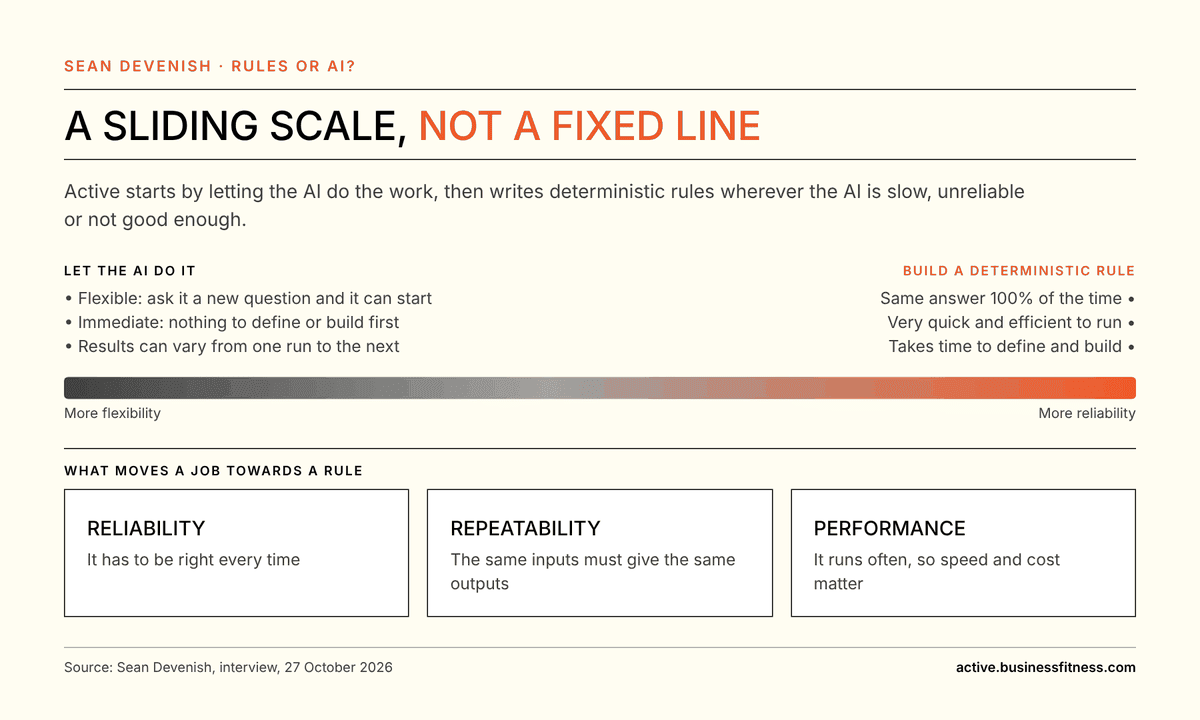
"It's an optimisation question. Deterministic rules give you the same outcome 100% of the time, with no variability, and they're very quick to run as well. So if something can be deterministic, generally you still do it deterministically.
The counter side is that rules have to be defined, and that takes time to build and write. With AI, you can just give it the question. So there are the benefits of speed, performance and reliability on one side, and the cost of building the rules on the other. It's a sliding scale. The more you care about reliability and repeatability, and the more performance is an issue, the more you're willing to spend that time building rules.
AI is inherently flexible and immediately capable of good outcomes, so as we build, we tend to let the AI do more work rather than less, and gradually create rules for areas where it's underperforming, a bit slow, or not as reliable as it should be."
The AI built into Active uses a mix of smaller and larger models. How do you choose?
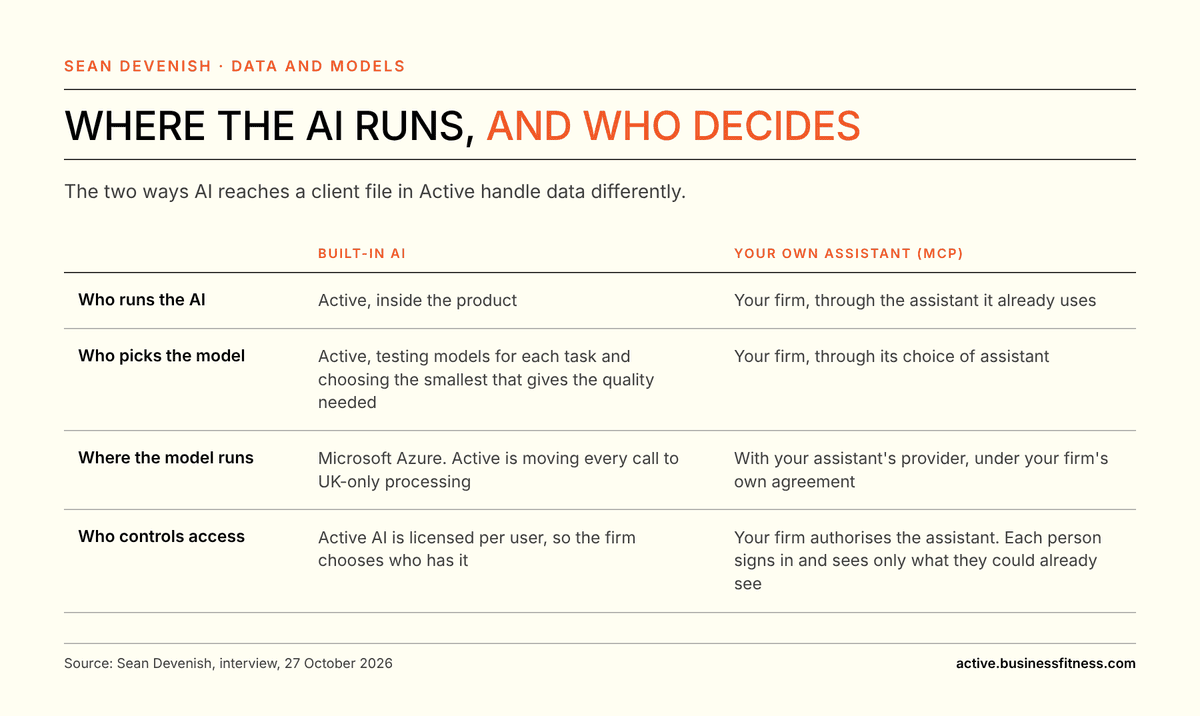
"You're trading cost for performance, meaning the model's ability to do a really good job on that case. Generally you want the most capable small model that gets you a good outcome.
For any given task, we test it against a range of different models to work out which give a great quality of output. If I get the same quality on a much cheaper model, I'm definitely going to choose the cheaper model. But sometimes you can't get the reliability we expect without a larger model, in which case that's what we'll pick."
Where does a firm's data go when an AI feature runs?
"With the open tooling, the firm decides which agents are allowed to access our data, and authenticates them. So the firm is deciding who's consuming it.
When it's an AI feature we've built ourselves, like our review agent, where the data goes becomes a lot more important. That's why we're forcing UK hosting on the models, so the data doesn't leave the UK. Most of those model calls go to Microsoft Azure, which has a UK region. Some of the models Azure hosts aren't available in the UK region yet, so as of today some calls can go to the US. We're refactoring so that all model calls stay in the region. It means limiting the models we can choose from, because not every model is available everywhere. We expect that to be resolved in the next couple of months."
Read more about how client data is protected and certified at Active.
Why connect to Claude and Copilot rather than build an Active assistant?
"An assistant is essentially a wrapper for an existing model. The quality you get from it comes down to two things: the model itself, and the harness around it, which is the memory and the instructions it's given to go and do a task.
There's a race on between Microsoft Copilot, Anthropic's Claude and OpenAI's ChatGPT, and these are phenomenal harnesses. They can work with other MCP servers, so you're not limited to our system. They manage skills, distribution and security. Even if we built our own assistant, it would only ever be a fraction of what they provide.
So we've gone agent-native first. We let those harnesses use our tools, instead of building an assistant that does the same thing in an inferior way. And by having our tools available, all that capability is suddenly available in our system. Claude can download documents, look things up on the web, and open and edit Excel files. So you can grab a workpaper from Active, edit it, and upload it back as a new version. If we built our own, that's a huge amount to rebuild."
"We feel that the open standard gives the best outcome for the user by a long way."
To connect your firm's assistant, see using Claude or Microsoft 365 Copilot with Active.
What happens over the next 12 to 18 months?
"Our main plan is to open up more tools. We're also aware that people don't necessarily know how to build agents, or how to use assistants like Claude and ChatGPT well enough to get the outcome they want. So we're building plugins and skills: preset processes and instructions you can give those assistants, so people have a starting point.
We've been publishing those already. For example, we have a client query management skill that tells an agent how to prepare a client query letter, assembling all the different information and looking at last year's job.
We're giving that away. It's public for anyone to see, including competitors. That's because we believe in where this is going, and we want people to experience for themselves how these agents can produce phenomenal results."
Find out more
Read the overview of how Active approaches AI, and the companion interview with Professor Hani Hagras of the University of Essex on explainable AI. Active AI is free until 31 December 2026, by invitation. To see it on a live file, take a look at Active's accounts production and book a demo.
Frequently asked questions
What is Active's approach to AI?
Active provides a governed platform that AI agents can work through, rather than trying to automate every process itself. The AI does the gathering and coordination, Active's controls track and version what it does, and a qualified person reviews and signs off.
Why doesn't Active have its own AI chatbot?
Because assistants such as Claude and Microsoft 365 Copilot already offer far more than an accounts software vendor could build. Active connects to them through its MCP server, so a firm uses the assistant it already has, with Active's controls underneath.
Does Active use large language models for every AI task?
No. Active tests each task against a range of models and chooses the smallest that gives the quality it needs. Jobs with one right answer are handled by deterministic rules, and the numbers in the accounts are run by Active's calculation engine.